
Our guide
Heat pumps and solar in Mid Wales: a plain-English guide
Everything we'd tell you over a cup of tea before you decide anything. No jargon, no sales pitch — just what matters for a rural Welsh home.
1. Will a heat pump suit my home?
Almost certainly, if it's designed properly. Heat pumps are already heating old stone farmhouses, cottages and barn conversions all over Mid Wales. What matters is the design, not the age of the house.
- Heat loss comes first. A good installer measures every room and works out how much heat the house loses on a cold day. That sets the size of the heat pump and the radiators.
- Radiators may need to be bigger. Heat pumps run most efficiently at lower water temperatures, so some rooms may need a larger radiator. Many existing radiators can stay.
- Insulation helps but isn't a precondition. Loft insulation and draught-proofing make any heating system cheaper to run. An honest installer will tell you if something is worth doing first.
- You'll need a hot water cylinder. Heat pumps heat water into a cylinder rather than on demand like a combi boiler, so there needs to be space for one.
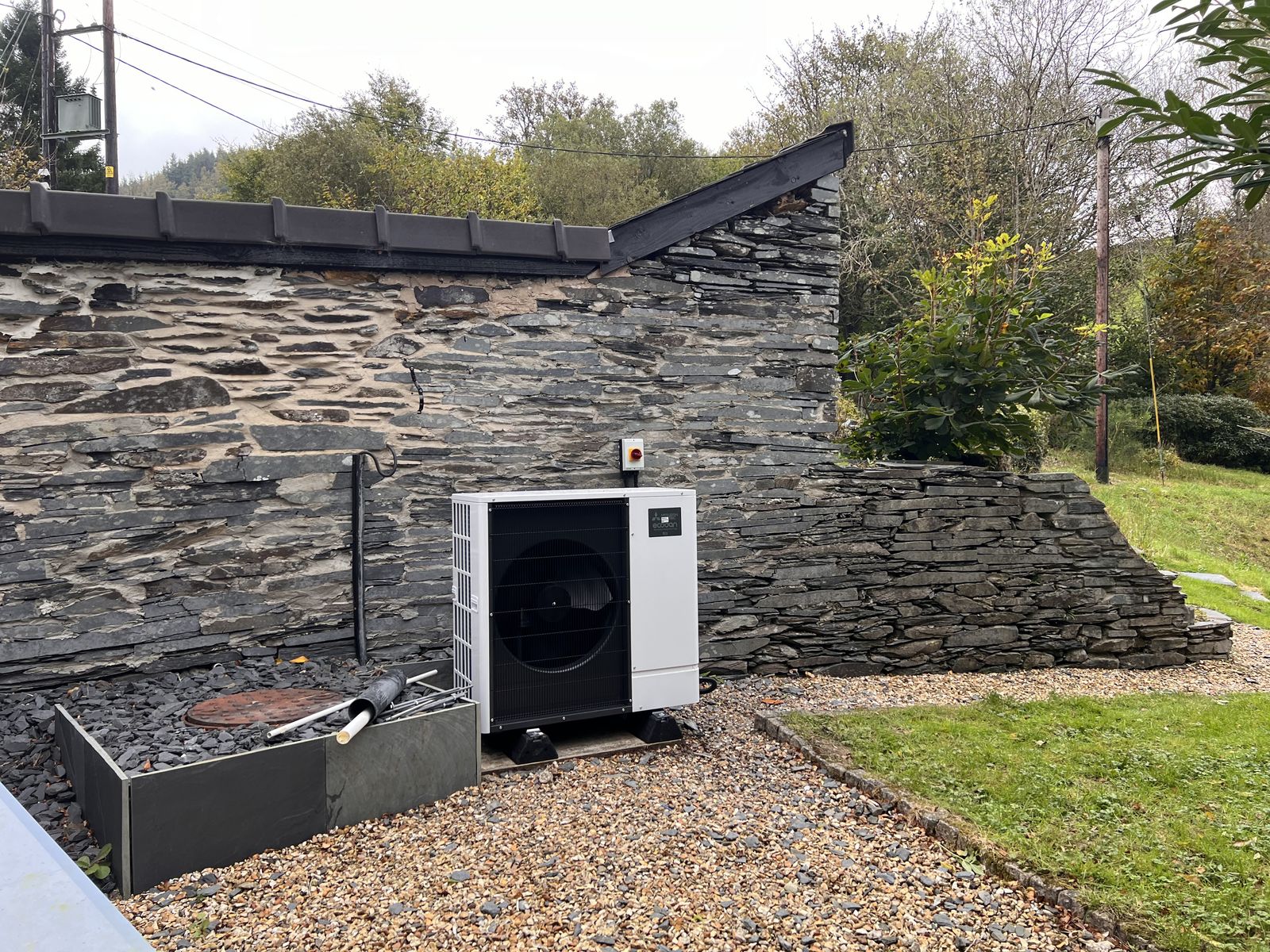
- The outdoor unit needs a spot outside — usually against a wall, clear of bedroom windows, with room for air to flow.
2. Air source or ground source?
Air source is what most people choose. The unit sits outside, there's no digging, and it's the most affordable to install. Modern units work well through a Welsh winter.
Ground source collects heat from pipes buried in trenches or boreholes. It costs more to install but is the most efficient all year round — worth considering if you have land to spare.
If you have a stream or spring near the house, a water source heat pump may also be possible. See heat pumps explained for more detail.
3. Costs and grants
Every home is different, so any installer should give you a fixed written price after a survey. Here's what brings the cost down:
- The Boiler Upgrade Scheme takes £7,500 off an air source or ground source heat pump — or £9,000 if your home is off the gas grid, for applications from 21 July 2026 to 31 March 2027. Your installer applies for it and takes it off the bill; you don't fill in forms.
- 0% VAT on heat pumps, solar panels and batteries installed in homes, currently until 31 March 2027.
- No more fuel deliveries — no oil or LPG to order, and no tank to maintain.
The grant needs the property owner to apply through an MCS certified installer, and most new builds don't qualify. Check the details on our costs & grants page.
4. Solar panels and batteries
Solar panels make electricity whenever it's light — on the roof, built into it, or on a frame in a field. They pair well with a heat pump, because the panels help power it.
A battery stores what you don't use during the day so you can use it in the evening, and can also charge from a cheap overnight tariff. Anything left over can be exported to the grid, and an energy supplier will pay you for it under the Smart Export Guarantee — you'll need an MCS certificate from your installer to sign up.
More on our solar & batteries page.
5. What actually happens
- A chat about your home, how you heat it now and what you're hoping for.
- A survey — measuring rooms, checking radiators, insulation, the electrics and where things will go.
- A design and a fixed quote, with any grant already taken off.
- The installation — the outdoor unit, cylinder, pipework, electrics and controls.
- Commissioning and handover — the system is set up, registered with MCS, building control is notified, and you're shown how to use it.
- A yearly service to keep it efficient and your warranty valid.
6. Questions to ask any installer
Whoever you choose, these are worth asking:
- Are you MCS certified for this technology? Without it there's no grant and no export payments.
- Will you do a room-by-room heat-loss calculation? If the answer is "we'll just match your boiler size", walk away.
- Who does the work? Your own team, or subcontractors?
- What guarantee do I get? MCS installations should come with an insurance-backed guarantee that protects you even if the installer stops trading.
- Who handles the paperwork? Grant application, MCS registration, building regulations and the network operator.
- Who services it afterwards, and where are you based? A local installer can come back when you need them.
Any questions? Call 07985 029139 or message us on WhatsApp — happy to talk it through, with no obligation.
Ready to find out what would work for your home?
Call, WhatsApp or email — or get an instant heat pump estimate online. We'll get back to you within one working day. No pushy sales calls.